Client: ASX-listed company
A structured, evidence-based assessment against the NIST Cybersecurity Framework provided the client with a clear understanding of their security maturity and a prioritised roadmap for improvement.
An ASX-listed company needed to understand their current cyber maturity. They engaged Fortian to conduct a technical review of cyber security controls against the NIST Cybersecurity Framework, covering key control gaps along with recommendations for improvement.
The client used the findings to inform a tactical security remediation plan and develop a longer-term security strategy to improve their cyber security defences.
Fortian applied a structured, risk-led methodology to evaluate the organisation's existing security architecture maturity, conduct an enterprise-wide cyber risk assessment, and develop a practical cyber security strategy. The methodology assessed not only what security capabilities existed, but how effectively they were implemented, integrated, and governed across the organisation.
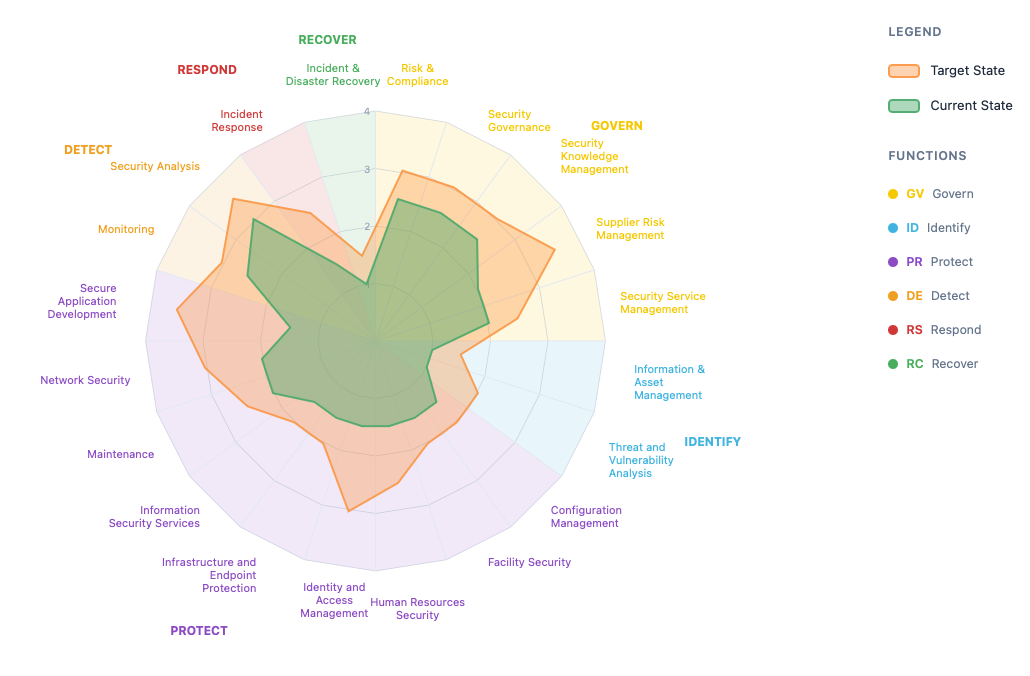
At the core of this engagement was Fortian's Security Capability Model (SCM), closely aligned to NIST CSF and incorporating relevant controls from other recognised standards (e.g. ISO 27001, Essential Eight). The model was tailored to ensure alignment with the client's organisational context and terminology.
The SCM is structured as a layered, domain-based framework around core security functions (Govern, Identify, Protect, Detect, Respond, Recover), with each function decomposed into security capability domains such as identity and access management, endpoint security, network security, cloud security, logging and monitoring, and incident response. Each domain was assessed across defined maturity levels, illustrating progression from ad hoc or fragmented controls through to integrated, optimised and continuously improved capabilities.
Fortian commenced by clearly defining the scope and objectives of the security architecture review to ensure alignment with business priorities and regulatory expectations:
This ensured the assessment was targeted, relevant, and defensible.
Fortian conducted a comprehensive current-state assessment combining technical depth with organisational context. Activities included:
This provided a clear view of design maturity, execution consistency, and cross-domain integration.
Building on the current-state assessment, Fortian identified architectural weaknesses and risk exposures through a threat- and risk-led lens:
This analysis focused on real-world threats and architectural exposure, rather than checklist-driven control gaps, and directly informed target-state definition.
Fortian worked collaboratively with stakeholders to define a pragmatic target-state security architecture and maturity profile:
The target state provided a clear, measurable, and achievable future security posture.
Based on the defined current and target states, Fortian performed a formal gap analysis to inform cyber security strategy and roadmap development:
The engagement provided the client with:
Fortian's Security Capability Model provided a structured, repeatable framework for assessing security maturity that went beyond checklist compliance. By combining deep technical assessment with threat- and risk-led analysis, the engagement delivered actionable insights that enabled the organisation to make defensible security investment decisions aligned with their business context and regulatory obligations.
Request a consultation with one of our security specialists today or sign up to receive our monthly newsletter via email.
Get in touch Sign up! Fortian
Specialist Australian cyber security. Consulting, 24x7 managed security and privacy services since 2013.
1800 717 545